History of the Super Nintendo Entertainment System (SNES)
Initial Release
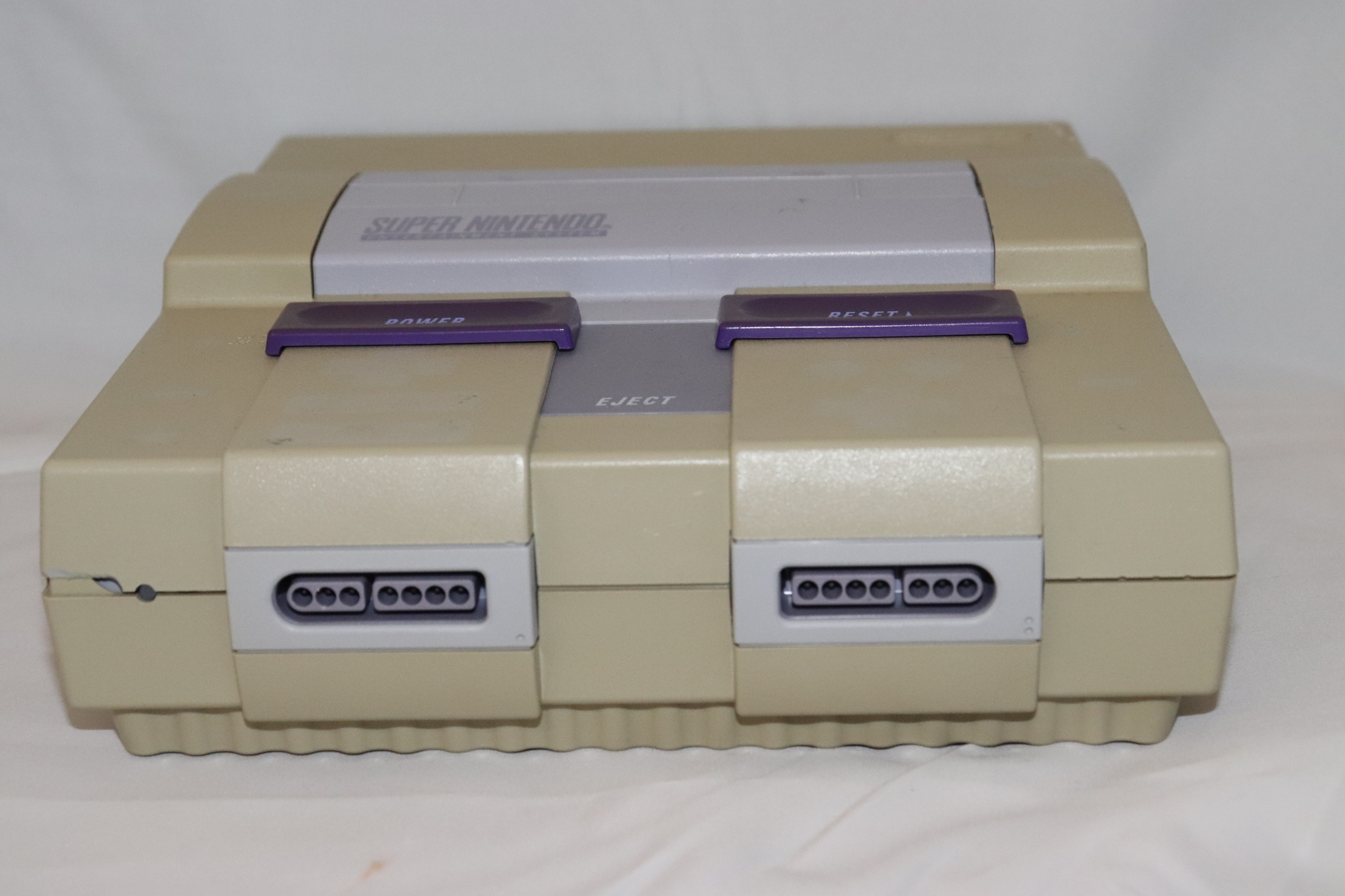
Following the global success of the Nintendo Entertainment System (NES), other companies began developing their own consoles. As the competition’s consoles became more and more powerful, Nintendo was forced to respond. As a result, they began working on the Super Nintendo Entertainment System (SNES). The 16-but successor to the NES was first released in Japan as the Super Famicom in 1990. Although only two games were available at launch (Super Mario World and F-Zero), the console sold out within hours. The SNES was launched in North America in 1991 at a price of $199, with a European launch in 1992. By then, many other games existed for the console from first-party Nintendo developers and third-party developers.
Features
The SNES was a stark upgrade from the NES, boasting a variety of new features such as true stereo sound, multiple scrolling backgrounds, and over twice the memory of the NES. It had the ability to rotate 2d sprites in order to create the appearance of a 3d scene, which was a must-see experience for gamers around the world. The controller was upgraded as well, with an additional two buttons added to the front of the controller, as well as two shoulder buttons added to the back of the controller. The shoulder buttons proved to be a great idea, and are still commonplace on gaming controllers today. The SNES also saw the return of many gaming franchises first popularized on the NES such as The Legend of Zelda, Donkey Kong, Final Fantasy, and of course, Mario. The console saw the emergence of new classics as well, such as F-Zero, Chrono Trigger, and Star Fox. In total, over 700 games were released in North America for the SNES.
Competition
The SNES faced many competitors; most notably, the Sega Genesis. The Genesis was released by Sega in 1989 as the next big console after the NES. It faced widespread success and proved to be quite the obstacle for Nintendo. Although the SNES sold quite well, initial sales still trailed the Genesis. A stark rivalry began between Sega and Nintendo over the sales of their respective consoles, often called the “First Console War”. Both companies released a series of advertisements designed to downplay the other. Sega chose to focus on branding their console as the more mature option, as it featured games that the SNES couldn’t due to Nintendo’s content restrictions. This proved to be a successful strategy, as it forced Nintendo to ease off on their content restrictions for developers. Meanwhile, an opposing sentiment also existed among the public that became concerned over the growing amount of mature content in video games. As a result, the United States Congress began holding hearings over violence in video games. As a result of these hearings, the Entertainment Software Rating Board (ESRB) was formed. The ESRB was tasked with analyzing content in video games and labeling each game with an appropriate age rating. The ESRB still exists today, and any game purchased for consoles such as the Xbox or Playstation will have an ESRB rating on the front. Ultimately, the SNES outsold the Sega Genesis over time, as a stronger game library filled with classic franchises from the NES era pushed customers to choose it over the Sega Genesis.
Legacy
The SNES era came to an end in 1999 with its worldwide discontinuation (although it was not discontinued in Japan until 2003). The console sold 49.10 million units in its lifetime, not quite reaching the success of the NES, but nonetheless leading its own era of video games. The SNES created a long-lasting impression in the gaming industry with its inclusion of shoulder buttons on controllers (which are still used today!), strong technological improvements over previous consoles, and the continued worldwide recognition of its mascot, Mario. The SNES’s feud with the Sega Genesis is also credited with the formation of the ESRB, which still exists today. Overall, the success of the SNES is something that console developers still aspire towards today.
Works Cited
“Super Nintendo Entertainment System.” Nintendo, Fandom, Inc., nintendo.fandom.com/wiki/Super_Nintendo_Entertainment_System.
“Super Nintendo.” Nintendo of Europe SE, www.nintendo.com/en-gb/Hardware/Nintendo-History/Super-Nintendo/Super-Nintendo-627040.html.
Wells, Kevin. “Press Start: A Journey through the Super Nintendo Entertainment System’s Past.” Power Up Gaming, Power Up Gaming, 22 July 2023, www.powerupgaming.ca/blogs/news/press-start-a-journey-through-the-super-nintendo-entertainment-systems-past.